Friday, November 4, 2011

Thank you Cards design your own

Thank you Cards


Thank you Cards design your own:
thank you sayings printable thank you cards wedding thank you cards sample thank you cards business thank you cards baby thank you cards online thank you cards baby shower thank you cards

Thank you Cards


My Sister-In-Law asked me to do some Thank You cards for her and here is what I came up with. These were a lot of fun and I got to use my new Cuttlebug and my Sandable paper on one of them.
This first card was the fanciest of the bunch. The paper had the design on the left side so I added the saying and stamped and embossed it with bronze embossing powder. Then I added the butterflies, a bronze flower, a few crystals and a brown organza ribbon with white poke a dots to finish it off.


For this second card I got to use the Cuttlebug with an embossing folder that was filled with all different Thank Yous. I used a sandable paper that was brown with a background color of of a peachy rose. Once embossed the paper I sanded all the embossing to bring out the background color. I added a tiny rose ribbon at the top and bottom of the thank you panel.

Thanks for stopping by to take a look.

Labels: ,

Friday, June 10, 2011

Experience Letter Format Sample for Green Card

Experience Letter


Experience Letter Sample Format for Green Card, see image for experience letter detail, and download complete experience letter-Green Card from this page.


sample letter format: experience letter Green Card. How to write Sample experience letter ? image is the answer


Download Experience Letter Sample Format for Green Card.doc (Microsoft word format)

Labels: , , ,

Saturday, June 4, 2011

business card: Optimal Size Design

Quick – name the single marketing item most widely used by businesses of all sizes. id you answer business cards? With business cards, we first begin to make an impression on the people who will eventually be our customers. Our business cards establish an image for our organization and us and provide information about how we may be contacted. And all this is presented in a familiar form that is easy to store and retrieve.

If this makes a business card sound like a wonderful marketing tool, that's because it is! By using some creativity and a bit of unconventional thinking, you can proudly present a business card that both stands out and really markets you and your company.

The first decision:
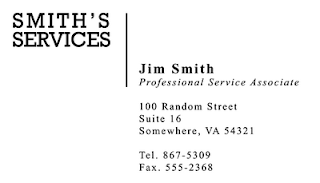
business card sizeSize A standard American business card measures 3.5 x 2 inches. This size fits conveniently into business card holders, protecting the cards before they are given out, and can be stored easily by the recipient in a business card binder or rotary file. Although using a non-standard size may tempt you as a way to present a memorable business card, do remember that your ultimate goal is to have the recipient store and later retrieve your business card. A standard size that can be stored in a standard fashion will accomplish this objective best.

The second decision:
Information to include Since the ultimate purpose of a business card is to provide information about who you are and how you may be contacted, the basic information to include on your business card is the name and address of your company, your name and title, your phone and FAX numbers and your email address. You may also wish to include aids to help others remember your name, such as a phonetic spelling or a nickname in parentheses. When important for image, consider adding your professional or academic designations and affiliations.

In today's world of wireless communications, you may find that your company's toll-free phone number, your direct phone line, your cell phone number, your pager number and your home phone number may not all fit on the business card. Be prepared to decide which of

These options are most likely to lead to success for the person who wants to contact you, and omit the others.

The third decision:
a logo The word logo is a shortened version of logotype, which originally meant an identifying symbol created from type. Today a logo can be created using art elements such as clip art, typefaces, photos, symbols, silhouettes, shapes and outlines, or a logo can be designed from scratch. But regardless of the method used to create the logo, there are a few basic rules that govern logo design. typefaces, photos, symbols, silhouettes, shapes and outlines, or a logo can be designed from scratch. But regardless of the method used to create the logo, there are a few basic rules that govern logo design.

The fourth decision:
Design Good design communicates an idea and equally considers function and form. Good design is visually striking and conveys an impression. Good design separates your business card from others and provides a wow factor as you hand your card to another person.

In The Non-Designer's Design Book Robin Williams describes the four basic principles of design:

  • Proximity, the grouping of like elements;
  • Alignment, the visual connection of all elements;
  • Repetition, the repeated use of visual elements; and
  • Contrast, a marked difference between elements

When designing a business card, the most important elements are proximity, alignment and contrast. Using the principle of proximity means that related items appear physically close to each other, giving the reader a visual clue about the organization of the business card. Thus, information related to the company (address, toll free phone line, FAX, web address) should be grouped and proximate, while information about the individual (direct phone line, e-mail address)should be grouped and not in close proximity to the company information.

Following the principle of alignment, nothing is placed on the business card arbitrarily, and every item has visual connection with something else. Alignment is what unifies elements that are physically separated (following the principle of proximity) and creates organization. Alignment can be achieved by building the design on a grid.

Contrast adds visual interest to a business card and also creates organizational hierarchy.
font with a bold san serif; light and dark ink colors.

The fifth decision:
Color Introduce color into your business card with paper, ink or both. The psychology of color is a topic in itself; here is a brief summary:

Warm colors (red, orange, yellow, brown) evoke danger, power, passion, strength, blood and war. When used as an accent, warm colors can stimulate people to make quick decisions.

Cool colors (green, blue, purple) signify nature, life, new growth, energy, faith, money, royalty, richness, power and sensitivity. Blue is deemed therapeutic to the mind and body.

The color white connotes purity, clarity and cleanliness.

Notice that all the colors are associated with words. Use this information to select colors that elicit the emotional response consistent with the visual image of your logo. The combination of logo, design and color will create the truly unique business card you desire.


tag of article

business card size disign, card business size, business card plan, business card buy, business cards, business cards for thankyou letter, business card usa size, card, cards, card cards

Labels: , , ,

Saturday, May 7, 2011

Save and organize business cards you receive

Collect business cards and save as many as you can. Collect them from people you meet at professional meetings, book clubs, reunions, school meet-ings, and other networking events. After a while, the business cards will start to pile up. How do you organize and keep track of the contact information on these cards? There are several options. You can physically organize busi-ness cards in a Rolodex or a binder that has plastic inserts with pockets for business cards.

If you have the discipline to do it, you can type the information from the business cards you collect into a contact management program such as Microsoft Outlook or ACT. If you want to save some time, you can use a scanner with text recognition software to electronically collect contact infor-mation from business cards.

CardScan Business card scanner www.CardScan.com

This device is a small scanner optimized for scanning business cards. Several models are available that can scan in black and white and in color. Once scanned, the software uses text recognition technology to auto-matically enter the card’s contact information in contact software such as ACT or Microsoft Outlook.

Labels: , ,

Use business card CD-Rs

A new digital twist on the traditional business card is the business card CD-ROM. It works the same as a standard CD-R, but is cut to approxi-mately the shape of a standard business card and has about 40 megabytes of storage capacity.

This new format is a great new and effective marketing tool because you can put things on the CD-R that you could never put on a standard paper business card. You can create a multimedia presentation or an interactive brochure, include samples of your work, or distribute software demos. If you want to burn your own business card CD-Rs, you need a standard CD burner. You can also purchase labels for your finished CD-Rs that you can print through your laser or ink-jet printer.

If you don’t want to develop, burn, and label business card CD-Rs your-self, there are many development and duplication service firms available to help you. Some mainly provide duplication services and print a more profes-sional label on your CD-Rs, while others also can develop an entire multimedia presentation for you.

Business-CD http://www.business-cd.com
This company can help you custom design a digital business card with a multimedia presentation and burn it on a business card CD.

next about Save and organize business cards you receive


Labels: , ,

Friday, May 6, 2011

Carry blank business cards

How often have you encountered this situation? You meet a great new prospect at a networking function. You ask for her business card, but she admits she either forgot her cards, ran out of them, or is having new cards printed up. You could give her your card and hope she follows up with her contact information, but that puts the burden on her.

The answer is to carry blank business cards. You can get a sheet of blank business cards and break them apart without printing on them or you can print blank forms with lines for name, phone, address, e-mail, printed on the card.

next about Use business card CD-Rs

Labels: , ,

Customize your business cards

business cards from your laser or ink jet printer, you can create custom targeted business cards. If your business services several different industries, you could create a customized card for each industry, emphasizing specific services or benefits for each type of cus-tomer. You could also create different business cards emphasizing specific services for your business. For example, if you are a graphic designer, you could have a card that emphasizes your general corporate design services and one that emphasizes your website design services.

next about Carry blank business cards

Labels: , ,

Rethink your business card

Don’t take your business card for granted. There are many ways to maxi-mize your message while minimizing your costs. You can have a quick printer make the cards for you or print them yourself on a color ink-jet printer. The advantage of using a printer is that the card stock is sturdy, and you can add special features such as raised letters. The disadvantage is that if you have to change anything (your phone number, address, e-mail address), you will have to throw out all your old cards and go back to the printer for more.

At a minimum, your business card should include the following:

Your name

Company name

Business phone number Cell phone number

Business address E-mail address Fax number

The URL for the company website.

In addition to all the information listed above, here are some tips for designing your business card:

Use a splash of color. Design your card in an attractive color that fits your company image. However, don’t use too many colors. You can have a graphic artist design a simple, one- or two-color logo or you can put your name or company name in a colored font.

Use both sides of the card. Rather than trying to cram all your con-tact information on one side of your business card, keep the front attractively simple and use the back for detail information. If you need even more space, use a folded business card format.

Leave space for notes. Leave space on the reverse side of your busi-ness card for you or the recipient to write notes. For example, if you attend a seminar and the speaker offers to send you additional information, you can write the specifics of your request on the other side of your business card. When the speaker goes through all the business cards collected at the event, your note will remind him or her what you’re requesting.

Avoid conspicuous titles. To make an impression or as a matter of pride, you may be tempted to include a title for yourself on your business card. You might want to avoid including a title such as president, CEO, or chairman on your business card. When you’re a one-person business, clients may question the purpose of such a title. Actually, the only time you’ll have

to use a title is when you sign contracts, particularly if you are acting as an officer of your own corporation. If you think you must have a title on your business card, you could use owner, principal, or consultant.

Reprint rather than mark up. If you have to make a change to the information on your card, have new ones printed as soon as possible. Avoid trying to salvage the incorrect cards and save money by scratching out the incorrect information and manually writing the new information. You can do this in a pinch if you are close to getting new cards, but hand-written corrections to one’s own business card project a poor image.

Put extra business cards where you need them. Have you every rushed out of the house to go to a professional meeting or a social event and realized that you forgot your business cards? You can minimize the situations in which you are caught without extra business cards by staging stacks of business cards in places and with items you are most likely to have with you when you leave your house. Consider storing your cards in your wallet, car, briefcase, personal organizer, and backpack.

Laminate copies of your business card. Someone should do a study to determine whether more business deals have been done in a Jacuzzi or around a swimming pool than on a golf course. When you attend water sports, you don’t have to leave your paper business cards behind. Laminate some copies of your business cards and stuff them in your bathing suit.

next about Customize your business cards

Labels: , ,

Maximizing Your Business Cards

Business cards are your most important paper marketing tool. In addi-tion to providing contact information, they are, in fact, a “small billboard” for your business. They are the easiest marketing device to carry and distrib-ute, so take full advantage of this medium. With numerous vendors available to print your cards, it’s inexpensive to include color and raised lettering. At least one vendor provides free business cards if you let them include their logo on the back.

Today’s technology provides many variations on this old workhorse. With preprinted card stock you can create different, custom versions of your business card and easily change information with little waste. CD-R business cards provide a way to distribute entire presentations in the palm of your hand. This new medium extends the reach of the little 3½ x 2 in. marketing device that amplifies our identity.

“An identity would seem to be arrived at by the way in which the person faces and uses his experience.”

—James Baldwin (1924–87), U.S. author. The Price of the Ticket, “No

Name in the Street” (1985; first published 1972)


next about Rethink your business card

Labels: , ,

business cards samples

sample of houston business card
1 business cards houston
2 business cards houston tx
3 business cards online
4 business cards templates
5 business cards designs
6 business cards free
7 business cards tomorrow houston
8 business cards conroe texas
9 business cards sugar land

Labels: , ,